Monday, August 27, 2012

Out of Sorts: A Naturalist in Another Place

Pacific Birds of Opportunity                   14 August 2012


Gulls are opportunists, no doubt.  So are ornithologists and bird photographers.     For now, in my flight of fancy, I wish to share a few images from this day.  Since my own “rules” for the blog is that each day in nature is devoted a single entry, this is one blog entry that will grow.   It was a very big day, so come back again and stay tuned! 


Washington State’s Olympic Peninsula!  We enjoyed a day of beauty and great luck.  Hurricane Ridge provided a spectacular show as Pacific Ocean sea fog rolled into the valleys and ascended as cloud cover into the high country, wrapping and embracing snow-capped mountain peaks and glaciers.   Broad-leafed alpine lupines and magenta paintbrush flowers were in full bloom, and Sitka black-tailed deer fawns made appearances in protective woodlots.


A lunchtime hike and a day of “making miles” by car put us (delightfully) behind “schedule.”   What, in all of the beauty of Washington, especially in vacation, could dictate a schedule?  Actually, that would be a ferry schedule.

We were the last car of the last ferry before sunset.  We made it.  As our ferry finished the short crossing and we were called to return to our vehicles, I noticed a rock pile full of gulls.  Sprinkled along the white-washed rocks were Western Gulls, Glacous-winged Gulls, and, more exciting to a Wisconsinite, the Heermann’s Gulls so unique to the area.    The sun dipped low on the horizon, warming the photography light and making my heart skip a beat.  How great it would be to get to those rocks!  That’s when I noticed the parking lot and easy access.  It would be a reality!


Within minutes, I found myself sauntering along through a diverse group of gulls, shooting images and feeling very lucky.  

A strange, high-pitched squealing or screaming soon caught my attention.  While I had first thought it may be young gulls, my taxonomist’s brain quickly placed the sound as “new and unknown.”  This was weird.  I knew it was a bird, but it wasn’t anything remotely close to what I knew!  I searched the rocks and quickly found the answer.  Pigeon Guillemot! Alcid seabirds!  While this may not be exciting for somebody living on the coast, this is bird Heaven for a Great Lakes mid-continent land lubber.  


I sat on a rock and took on a low profile, waiting to see what would happen.  Within minutes, Pigeon Guillemots were flying from open water to rocks and perching on their hocks just a few meters away!  Here, before my eyes, one ecological lesson played out in grand fashion—Phosphorus cycling.  As phosphorous, a valuable and limiting nutrient is extracted from the sea through the food web, it is the birds that fly the phosphorous high and above the sea.  In their droppings, they deposit the valuable nutrient back along the edges of the sea where it slowly erodes from rock faces, back to the beginnings of the food web.  It is the wings of sea birds that cycle the Phosphorus and so contribute to the continuity of life’s webs. Bird guano whitewash is beauty on the rocks.


I had always known from pictures that pigeon guillemots were black and white seabirds, but I never appreciated how unique they are.  Bright red feet, to my sudden surprise, were complemented by a bright red mouth.  In the evening light, these birds glowed. 


Wildlife images were made with my favorite combination: Canon 40D and 300mm f4 IS lens.  I shot Aperture Priority, but I worked the exposure compensation a bit.   Landscapes were made with the Canon Powershot SX230HS, a camera that continues to surprise me with its quality as a “point and shoot.”

Friday, August 3, 2012

Breakfast with a Tanager

A Young Bird Reveals Volumes About Feeding Niche                    3 August 2012
Scarlet Tanagers are tropical birds, spending most of their lives there.  But they are hatched in the temperate portions of eastern North America, and the beginnings of a journey to the tropics are hinged on the successful exploration of a feeding niche in northern climates.  This Scarlet Tanager was likely a Wisconsin nestling just a few weeks ago, and it is on its way to Central America. 

I shared my breakfast with the tanager this morning.  This, of course, requires clarification.  I did not share food with the bird, and we did, in fact, have different feeding niches to occupy.  But the simple fact remains that, while I was perched on my deck, the young tanager was perched in an elm at the corner of the deck.  I got a front row seat into this bird’s search for food while I enjoyed some good grains.  I am glad I didn’t eat what the tanager found.   

The tanager seemed obsessed with a strategy of staring obliquely along the decurved leaves of the elm boughs.  If you haven’t peeked ahead at the images, perhaps you can spot the bird’s meal before it does.  The meal is clearly visible in one of these images!   A sharp eye is part of the tanager’s exploration of leaves for insect prey.   

The beak of a tanager is a piece to the puzzle, defining an opportunistic life building a diet rich in insects and fruits.

August has arrived, and tropical species of birds have already begun their southerly waves of migration.  Despite the sometimes oppressive heat of the “dog days” of summer, a hint of autumn is in the air in the changing hues of tree leaves, in the ripening of late berries, and on the bustling wings of chatty fledglings and migratory birds.  Everywhere, food abounds!

These images were made in lightly overcast, even light with a 300mm lens (Canon f4, IS) and a Canon 40D.   I shot at ISO 200 and ISO 400 to keep shutter speeds high.  The young bird was somewhat tame.  A fluffy white line along the bird’s wing left some doubt as to the bird’s identity, so I crept back into the house to get the camera.  My initial efforts were to simply document a “Western Tanager” in Wisconsin.  As it turned out, the bird was a Scarlet Tanager common to my locale, but the role of the camera quickly changed from species documentary  to behavioral documentary.   

Monday, July 23, 2012

Slow It Down

Some Good Advice                   Photographed on 29 June 2009

Slow down. You move to fast. You've got to make the moment last... Simon and Garfunkle did that one a while back, and it's good advice.  When the light is soft, dial back the camera (metaphor) to a low ISO, find a steady rest (metaphor), contemplate the composition (metaphor blatantly obvious).  Let the light slowly paint the image while you are cherishing the moment you are creating (still a metaphor).   Repeat as often as needed.  Relax into good art.


I have made it!  Vacation (really) starts tomorrow and is a near certainty well into August.  Breathe. Smile.  Stare at the sky.  Enjoy loved ones.   Dialing back to ISO 100, composing well, and slowing it all down.


To make these images at Amnicon Falls, I used a very small aperture (very large number) and a steady camera.  Because I didn't have a tripod with me, I found a small white cedar tree, looped the neck-strap of the camera around the tree and put the lens into it like a sling (hard to describe effectively).   My tripod for these shots was an organic one, and a sacred tree in these parts.  Miigwetch!

Sunday, July 8, 2012

By the Dawn’s Early Light

A Nature Photographer’s Enthusiasm for Promised Light  13 July 2009

Awake at 3:45 AM is the standard for a field ornithologist surveying bird communities. I love the old fighter pilot terminology for this, “O’Dark Thirty.”  By that measure, the wake-up at 4:10 AM for a wildlife photographer is “sleeping in.”  In the long summer days of June and July, dawn takes its sweet ol’ time, waking and stretching and yawning for nearly an hour before the deeply orange sun breaks the horizon.   Dawn rolls out with a slate blue sky, wiping stars slowly away.  It progresses into a pale orange glow that pushes the blue away, sometimes with a nearly white, pale blue line of separation.

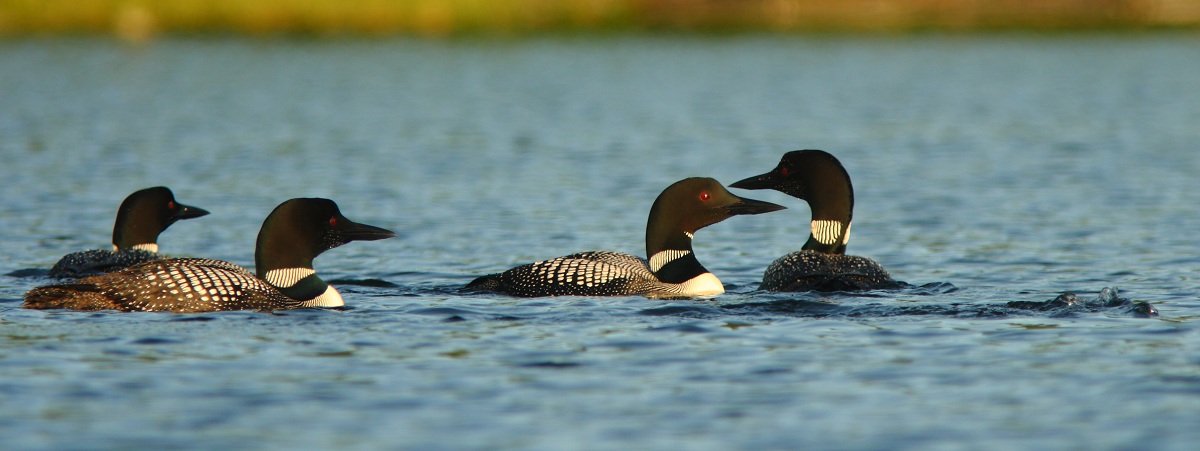
 The sun begins to hint at an arrival, and the world begins to glow, seemingly from within, as the clear sky erupts with color from the East.  By this time, my kayak has slipped into wild waters.  I’m on the trail of loons who, one evening before, hinted at a mass arrival in the morning.   I think I know where they’ll be, and I paddle with anticipation, my camera wrapped in a light rain coat and nestled with care ahead of my kayak’s cup holder.  The Common Loon holds many gifts that, for those who sleep in, are not too common.  My camera awaits this uncommon spectacle.

My knees protect the camera from the lake’s danger like a mother loon.  The water is smooth, silk, glass, and my kayak sends a gentle ripple of transformed, deep woodland reflections to each side.  As the sun seems to ignite rising fog, the loons begin hailing their arrival with flight tremelo songs.  In an act of purely aesthetic joy married to calculating science, I close my eyes, raise my chin to the sky, and triangulate with precision the vectors of loon arrival. 


Aiming the kayak for the first splash-downs, I work carefully, respectfully, calmly into position to intersect a loon social gathering.  The sun is at my back, rising along the horizon, providing perfect nature photography light, masking my human form.  Loons on the water hail inbound loons with a higher pitched social “Hoot,” and more loons make their plunging descent into the lake.  They enter into their circle dance, a strange, promenading square dance that goes on almost every morning in loon country. 


Each loon, bill turned downward to the water, seems to look into the circle and study each and every bird in the dance.  When a loon dives, the crowd bristles with anticipation, a loss of trust, a worry about pecking order aggression from the depths below.  Often, as a loon surfaces, the whole group of loons begins to splash and dance about, chasing, dipping, diving, surfacing, whirling, and calling.   There are moments of serene unity, moments of closeness, and dramatic moments of indecision and chaos.


Yodel calls by males in the group proclaim intentions for mates and territory.  Brisk confrontations sometimes end with a high-energy “penguin dance,” a burst of power on the surface of a once-calm lake.  Sitting low on the water, a kayak among loons gives an incredible perspective into the lives of these ancient water birds. 

By the time most people have taken a first step from the comfort of a bed, I have greeted the dawn, paddled wild waters, and learned more about a small group of birds than a volume of books could ever convey.  By 7:45 AM, I am already pulling the kayak to shore.  It has been a great day.  The best days begin with a dedicated, early start and the dawn’s early light.   
\

Special Thanks to Fran and Dick Bukrey for their generosity and hospitality.  It was the gift of a 2X teleconverter from Dick back in 1986 that gave me enough success that I was encouraged to move forward in the pursuit of bird photography.  And it was the magic of their kayak and lake home that put me in position to make these images.  Thousand Thanks!


All images were taken with a Canon Rebel XTi (my “expendable” kayak and pack camera) and my older Canon 300mm f4 IS.  The Canon Rebel XTi has a 10 Megapixel sensor and delivers professional quality, but the sacrifice in price leaves me with a slower frame rate and a longer memory cache time.  For every three images captured, four were never made when comparing to my Canon 40D.  Still, I think I did alright.  Early light on the water can be deceptive, so I routinely under-expose 1/3 stop to prevent "burn out" on the loon's white highlights.  Using the early light of morning and a fast shutter speed to freeze dancing waters makes for drama in an image.  Photography is intended to allow pensive reflection within a moment in time, and wild waters, warm light, a quick shutter, and a kayak's perspective deliver this well.  The images of this loon's "penguin dance" were made after an intense confrontation between loons.  If a loon ever does this dance in the absence of other loons, it is very likely that you have caused it extreme stress, indicating that you should back away and give it the space it needs.  While we interact with the wild, it is important that we offer our sincere respect.

Monday, July 2, 2012

Bogland Beauty

Without Trails   July 1, 2012

Morning bog beauty
A trail gives a reason, a direction, safety, ease, comfort, access to beauty, all with the convenience of a known route and a near certainty of safe return.   Trails prevent us from loving our resources to death, preventing erosion and large numbers of people from aimlessly walking over small and fragile habitats in our state and national park systems.  Trails allow accessibility, granting the same spectacular views and explorations to people of all ages and abilities.  Trails give day-hikers the speed to get to a mountain pass and back to the safety of a waiting car in the same day.  For a thousand reasons, trails are good for people and the places we love.  But there is also a paradox of trails, a granting of access to things most obvious, and a consequential personal removal from things precious, rare, and well hidden.  The express way to nature may prevent us from better knowing nature.  After all, it is that mosquito toll we pay that grants us access to a deeper understanding.      


Black Spruce and Tamarack Bog
There are many varieties of trails and more types of trail-users.  On the one extreme, we drive our cars on the largest and most obvious of trails, sometimes as fast as 80 miles per hour.  These trails have become the enemy of land, animals, and ecosystem integrity.   On the other extreme, we may follow a small game trail through an otherwise impassible tangle of briars and lay-downs, seeking a personal connection with the land.   Most often, people seeking nature will use moderately wide trails of gravel, wood chips or bare earth.  These trails are minimally invasive gateways to a world of broader vistas and joyful “handshakes” with nature.    Aldo Leopold equated safety to dullness and boredom in his essay, “Thinking Like a Mountain.”   I understand trails in their many shapes, forms and reasons, but I don’t always agree with a good trail.  Sometimes I don’t like a day of planned certainty.   I like the mosquito tollway and the adventure that comes from not knowing what awaits my visit.

Pitcher Plant, a bog plant that lives in acidic waters amid blankets of sphagnum mosses.


Modified leaves form the vessels that allow this plant to function as a carnivorous plant.


Pitcher Plant: The red veins secrete insect-attracting nectar…

Pitcher Plant: Insects and other small animals fall into the pitcher and cannot escape…


Pitcher Plant: A flowering plant with an unusual but otherwise typical flower…
Even bog lands have trails.  Animals, especially deer, must safely negotiate these earthly sponges with energy-saving efficiency.  A timeless trail network appears through an unbelievably slow succession in a microbially starved ecosystem.  Peat mosses are compacted until water stands above them but footing beneath is firm and forgiving.   I love these sloppy, knee-deep trails, but they do not always lead where I must go. I divide my time between careful negotiation of hummocks and root mats and the wet, trusty deer trails.  In soggy habitats, the biggest sin is to keep your feet dry.  Accept wet feet, step with calculated confidence, and you will likely stay safe.  Seeking dry feet invites an accident and is tough on a landscape so slow to recover.  To visit a bog, I owe it to the bog to be well behaved.  Bogs are preciously rare and sensitive to trampling.   So…Which deer trail do I take next?

The trail less traveled, the trail made and visited by only the four-legged animals, is the trail for me.  A walk through a bog requires attention to details as I strive to preserve life and understand unfamiliar beauty.  I move slowly and am constantly in awe.  Every species brings the question, “has anybody discovered that before?”   Yes, it seems most everything has been described by science, but there are still discoveries.  Even questions of a plant or animal’s well-being and geographic distribution must be answered.  So, with care for the environment and with a light step, I venture into the bog on trails unknown by humans and traveled by bears, deer, raccoons, snakes, and frogs.  As long as people choose not to visit bogs, they will remain beautiful wilderness.  A paradox of wilderness is that the best wilderness is that which is not seen by humans.  Every once in a while, though, I encourage you to find a trail less traveled, a day of unpredicted, uncertain joy, a visit with nature that brings you something new and opens your heart to the possibilities!

Rose pogonia (Pogonia ophioglossoides)


Black-throated Green Warlber in Tamarack Tree


Lincoln’s Sparrow, a subtle beauty with an amazing song


Cottongrass sedge in flower reminds me of a Dr. Suess truffula tree


A skipper butterfly on tamarack…Another “what is this species?” moment!

Images were made with a Canon Rebel XTi, my older 300mm f4 Canon lens (this is my old “throw it in the backpack” pro gear for treks like this!). Other images were made with the Canon Powershot XS230HS.  A partly cloudy sky and early morning light gave these images their color hues and any kind of magic.   Step carefully and leave no track or trail, no trace that you were ever there!