Saturday, April 20, 2013

Make a Splash!

April Showers Part II                           19 April 2013

Dark-eyed Juncos in the blizzard

The late April snows continued, blowing nearly a foot of new snow into the Saint Croix River valley of Northwest Wisconsin.  Winds blew hard from the North, halting bird migrations and pushing all wildlife into shelter and into feeding frenzies.   While the snow was deep and drifting, the temperatures remained forgiving, dipping just below freezing.  

Fox Sparrow

Fox Sparrow

Fox Sparrows

By this date on most years, I'd be listening to the chorus of Spring birds, hiking past blooming Hepatica and Blood Root to soak in the blending warm and chilled air currents drifting along a lakeshore. Green plants would be piercing through dead leaves as they pushed toward the sun.  By this date on most years, I'd be pitching waxworms to the bluegills hovering in the shallows and rejoicing in Spring with a Friday night fish fry that had started with an evening peace of Song Sparrows, robins and loons.  Sunset would dance in surface ripples, set to motion by a dancing fish.  

Common Redpoll, Spring lilac

Purple Finch, Spring Lilac buds and more snow

House Finch

The driving snow cakes the pines and low shrubs, bowing down the limbs and making secret hiding places for rabbits and resting birds.   While I watch the birds at my sunflower feeder, I find them to be very active.  In reviewing my first few images, I suddenly realize that I am making imagery of blowing snow and a wintery vision of kids kicking puddles, making an April splash.  The busy birds are making a secondary snow storm underfoot.  Splash!
Fox Sparrow

Fox Sparrow

American Robin

Dark-eyed Junco landing long...

Everybody has a different strategy.  The Fox Sparrow "kick scratches" to remove snow from seed.  The Blue Jay scatters the flock with a resounding alarm call.  A Purple Finch, out of his element and down on the ground, uses his wings like snowshoes to avoid falling in over his head.

Fox Sparrow "kick scratch" in action...


Purple Finch "snowshoes" in deep snow...

By 2 PM, I am at the hardware store buying more seed.   Bird numbers seem to be growing as the feeding frenzy continues.  As I drive to school to shut down the lab (snow day) and deal with the unexpected, I see flocks of Hermit Thrushes drifting in the wind and scattering to the low lying shrubs.  Home safe, I hunker down with the birds and watch the storm give way to a hidden warmth of Spring.

Dark-eyed Junco, female

Dark-eyed Junco, "Oregon Junco", a Rocky Mountain bird in Wisconsin...rare treat!

All images were made with a refurbished Canon 7D and my trusty Canon 300mm f4 L IS lens.  There was more light today than yesterday, so I was able to shoot faster and freeze the action.  

Thursday, April 18, 2013

April Showers Bring...Snow.

Feeding Frenzy in a Spring Snowstorm                   18 April 2013


Fox Sparrow

April Showers

Dark-eyed Junco

Fox Sparrows, Eastern Meadowlarks, Killdeers, Red-winged Blackbirds, Brown-headed Cowbirds, American Kestrels, and Merlins... Make no mistake.  Spring is certainly here.  Great Blue Herons are tending nests at Interstate Park.  Bears are ambling about.  Spring for sure.  Yup.


Fox Sparrow

Here in Northwest Wisconsin, lake ice is still frozen (even on the ponds) and we just accumulated another eight inches of snow.  This time last year, we had bluebird skies, leaf buds breaking, and warming waters in all of the north bays.  If climates are like people, the tension zone between boreal taiga and temperate deciduous forest is that interesting personality with a tendency for drama.  Steady and same is just too boring, I suppose.  We have a Mother Nature that needs some adventure.

Fox Sparrow

Fox Sparrow

I suppose that is also why those of us that live here choose to stay.   Every season is different.  There are four seasons written into the history books, but I have never seen a single season repeat itself in my lifetime.  Every year is remarkably different.  Last year, maple syrup harvest was spent by the last weeks of March.  Today, it's still running.  Grass was green this time last year.  Not sure what grass looks like this year.  Last summer's drought left a lingering thirst in heat-stroked trees.  This Spring, the thirst is quenched in the promise of snow melt.  But will the snow ever melt?  Sandhill Cranes, migration-starved and eager to lay eggs, must be asking the same question.

Common Redpoll

Today, in the driving snow, a large flock of Dark-eyed Juncos descended enthusiastically, frantically upon bird seed, joining the small band of Fox Sparrows that had hunkered down for the week.  Purple Finches freely mingled with the House Finches, and a Common Redpoll, too far south for the season, looked right at home in "winter."   The birds were lively and brought color and joy to the snow-swept landscape. Suddenly, all birds scattered and froze in the lilacs.  Drifting along the wind, dramatic in the gray and white storm, a Cooper's Hawk cruised low over drifting snow, darting between spruces.  When the coast was clear, all of the frenzy began anew. It was a good day along the tension zone.

Purple Finch

Dark-eyed Junco

Fox Sparrow

Fox Sparrow and Common Redpoll, Spring meets Winter...

All images were made with a refurbished Canon 7D and a prime Canon 300mm f4 L IS lens.  

Wednesday, April 3, 2013

Rivers of Change, Rivers of Life


A Place for Otters                  15 February 2010


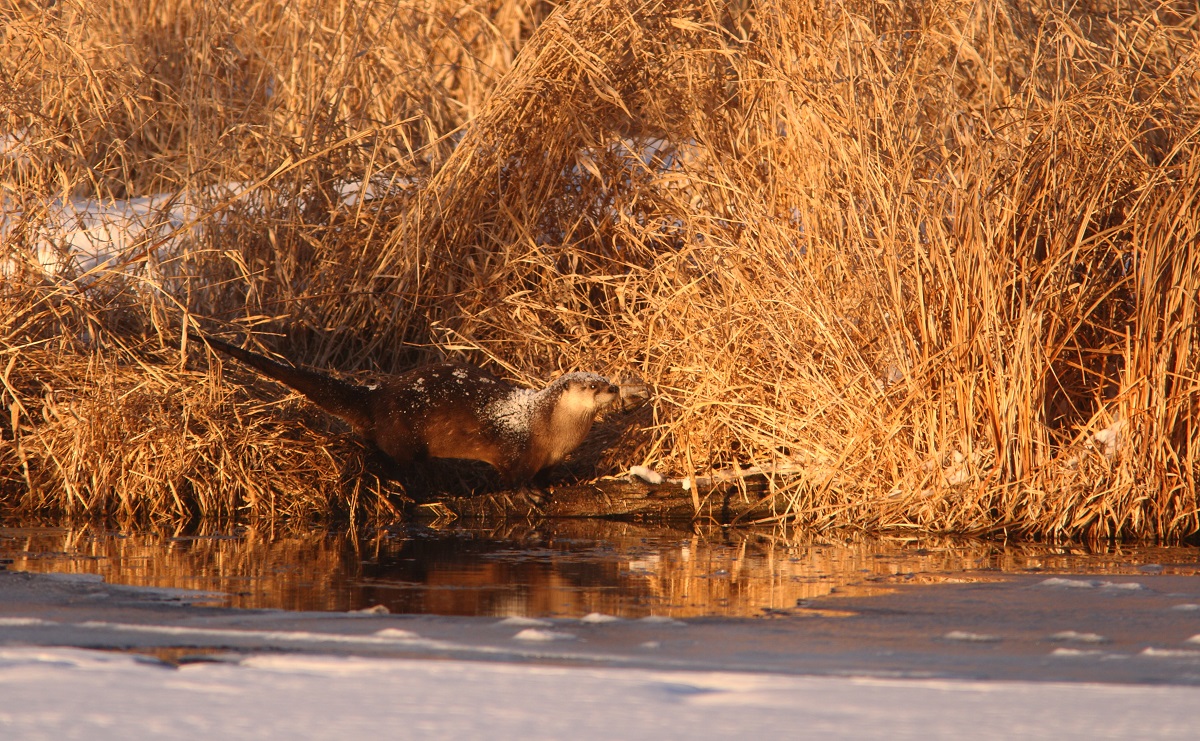
Just feet away, the otter surfaced with a golden fish in its mouth.  It chewed enthusiastically, mouth open, rolling the crumbling fish around on its bony pallet.  Each time the otter had gone under for a fish, I had slithered along the ice to get closer.  Each time the otter surfaced, I froze still.  When the bubbles began rising just a few arms’ lengths away, my heart leapt in anticipation.  When the first otter surfaced with another fish, I entered “work mode,” fully engaged in the process of making pictures.  When the second otter surfaced, I felt all of nature smiling on my good fortune.  With each image I made, I worked less, lived more, and made sure to soak in the joyous moment. 


As clean water springs and seeps bubble out of the ground and spill into the back bays of the Saint Croix River, the unique flows maintain streams and pools of open water that last all winter. This is a phenomenal source of life amid a snow-swept landscape, concentrating animals from all around.  


I prowl the river miles, up and down, learning the ins and outs that bring me closer to the lives of these animals I cherish.  I come to know the otters, eagles, and swans as friends, and they grow used to my presence.  I bank on some small degree of certainty that this bounty will remain and that I will have the time to learn it to perfection.


But this is a river, and rivers are always changing.  This small stretch of river has given so much, but it is no longer the same stretch of river. 


A vast and powerful flood of early spring 2011 brought sand and silt into the back bay, filling in a long, deep channel that used to bring fish and would then attract many animals.  Since these photographs were made, the system that served the otters has moved elsewhere.  A new story will surely develop in this spot that I once knew and must learn again.  The otters are busy writing their own story nearby but undiscovered by me.


I can only hope that the slow and steady march of river waters will scour out the channel and bring the fish again.    It will return the system as I knew it.  I have no worries for those otters, though.  They know what they are doing, and this is a great, wild and clean river with many other places to hunt.  Perhaps the otters know better that they can now fish without having to worry about my own doings.  They are resilient survivors and the product of an ever-changing river course.  


All images were made with a Canon Rebel XTi and Canon 300mm f4L IS lens, my usual dedicated prime lens.  I lay on my belly on the river ice and moved only when the opportunity allowed, paying attention to ice safety and the otters’ needs.  Eventually, the otters permitted me to enter into their realm, and I made as many exposures as I could in the brief time we shared. 

Wednesday, March 20, 2013

Steady Swans in Golden Light


Ma and Pa Trumpeter Swans                                18 March 2012


Winter has a good grip on us this year, and I am reminded by the frozen lakes and sharply shadowed edges of drifted snow that we will see remnants of this winter well into April.   I have been spending too much time indoors, but not because of the weather.  Work beckons constantly as my own expectations are ramped up in times when governments forget to invest in education.  Each member of the educational family feels the squeeze, and, I suppose, some of the animals I have come to know are wondering about the absence of my silhouette on the distant drifts, my lurking about in curious ways.


There are two wild trumpeter swans I have come to know well, and for a few years I have called them “Ma” and “Pa”.  My kids call them “Slurper” and “Guzzler” as a tribute to the way swans feed in the early spring.  They don’t have neck bands, so I can’t read their names.  But there is something about them that is unchanging, constant, and certain.  When I see them again this year on territory, I will know it if it is still them.  I would be willing to bet a lot that I will see them again in the same place, doing the same things.


The weather is never so constant and certain.  My favorite swans are still making circuits around the landscape.  This year, I can only wonder where they are and what they are doing now.  In a few weeks, the pattern will resume, and I will pay a heartfelt visit to “Ma” and “Pa” as they take care of things in a small wetland I love so much.  Every duck and goose knows who owns that water.  They give these swans a wide berth.


Let the snow keep coming, at least for now.  This land needs the drink.  The swans need deeper water.  Last summer’s drought was difficult for local swans as the shrinking natural “bowls” of water placed the shallow margins closer to the middle.  As our local swans fed for tubers and picked up gravel in the areas that were now at just the right depths, they encountered an abundance of forgotten lead, left over from the days when hunters threw toxic shot relentlessly toward the middle of marshes.  We lost a few swans to lead poisoning in the late summer, and I can’t help but feel anticipation for the thawing ice and open water that still has yet to come.


 I look forward to checking on my old friends to see if they are here for another season.  I imagine we’ll throw out a small wool blanket across the grasses and watch the swans as we eat a snack and bask in the early spring sun.  My kids will watch through binoculars to see details in birds that are already very close.  We’ll sit for an hour or two, entertained by these beautiful birds, and we’ll say very little as we enjoy this time together.  I can guess this will happen, because, like “Ma” and “Pa”, some very few things are still wonderfully unchanging, constant, and certain.


These images were taken with a Canon 30D and Canon 300mm f4 IS Lens.    

Thursday, March 7, 2013

Maple Shadows and a Hint of Spring


Onaabani Giizis, Maajigaa                                         6 March 2013
(March, Crust on the Snow Moon, The Maple Sap Begins to Run, in Ojibwe Language)


Earlier than usual in this day and age, the maple sap runs in early March when the days are warm and the nights still brisk and cold.  As the snow crusts over and then melts from the base of the tree, it is time to harvest the sap to make maple syrup.   I took this picture as the sun set upon a ridge of sugar maple trees, casting long shadows.  March brings a sun that is much higher in the sky at mid-day. The energy of the sun evaporates the snow and melts the surface, even when the greater air temperatures haven’t lifted above freezing.  I felt that the warmth of the sunset colors made a fine tribute to the warming air of March.   I made this picture with a small electric radio-controlled fixed-wing aircraft and Kodak Playful HD camera.  The lower quality of the image made by a “screen capture” of the video coupled with the unusual perspective brought to mind the playful and retrospective art being made by modern photographers using tiny 110 negatives and other “obsolete” equipment.  I was thrilled to get this image back, as all of my flying is “LOS” or Line of Sight.  I never know exactly what the airplane sees until I get my camera back! 

Minogiizhigad geget! Miigwetch!  

Sent from my iPlane

Tuesday, March 5, 2013

Snow Day!

...And the Snow Kept Falling!                  5 March 2013


A hot sandwich, a warm tea, and a few local friends just outside in the wild.  For a teacher, a snow day is still a work day, but it takes on the gentle and muffled relaxation of academic progress in solitude.  While I dreamed of a new sort of future in the life sciences, the local late winter wildlife kept me entertained.  


Canon 7D, 300mm f4 L IS, black oil sunflower seed, and Peace on Earth.

Monday, March 4, 2013

Snowy Days


Snowy Egret, Sanibel Island, Florida                         18 February 2011


As I write today, 4 March 2013, a brisk snow is covering my Northwest Wisconsin home.  Horned Larks, taking short flights from the gravel roadsides to the open blankets of snow, are abundant reminders that Spring is not far away.  We have already seen a large black bear ambling across corn stubble, making his way to a bramble thicket. Tonight, a storm promises to bring Winter for a longer stay.   In all honesty, I am thankful, as I still want to get a few more moments in the snow-swept wild.  Maybe (though not likely) we will have a snow day tomorrow.  This brings me back to a different sort of snow day, a warm and sunny snow day a couple of years ago in February.  


The Snowy Egret is a southern bird, a bird of coastal mangroves, bayous and coastal retreats.  It is a small bird with elegant plumes, and it wears a spectacular pair of golden slippers.  Unlike our own Great Egret, the Snowy Egret has a thin, black bill.  In many southern locations, the Snowy Egret is tame and abundant.  It is a spectacular reminder that conservation laws can work.  It is as pure as freshly fallen snow.  A day with this bird is one of the best kinds of snow days to nurture a soul. 


The Snowy Egret was a bird nearly wiped out by the plume trade a hundred years ago, and, like so many things wild, its recovery has given us a generation of dedicated conservationists.  It has also given us a paradox.  Many people younger than me have been born into a world that is once again rich in an abundance of big and spectacular birds, all back from the brink, all survivors of those less favorable days of unregulated market hunting, wetland destruction, DDT, and an ongoing list of things since abolished or better regulated.   It gives us a frailty, a false sense of security.  Our young people must grow to love what we have and never, ever, ever forget…that we once almost lost it all.  Our young people must be inspired to know that it was the determined hard work and anxious concern of previous generations that kept these living treasures around through each growing pain of the industrial revolution. 


What decisions will we make? What decisions will we allow? What legacy will we leave?  It is not enough to celebrate our successes.  We must also contrast them with the mistakes of the past, show the successes as better days, and work tirelessly to secure a great future for the beauty of the wild. 


The greatest conservationists are and were long in vision.  In difficult times, we must also honor them by being equally long in vision.  Exploitation was a mistake of the past, and it is something we cannot afford today.


All images were made with a Canon 30D and Canon 300mm f4 L IS Lens.  The light was spectacular as the sun went down near the Sanibel Island lighthouse beach.  The fishing pier and beach at this location are a good bet for any bird photographer!