Monday, September 10, 2012

Among the Old Growth

Walking in a Strange Land, Senses Aware and Open                   August 12, 2012

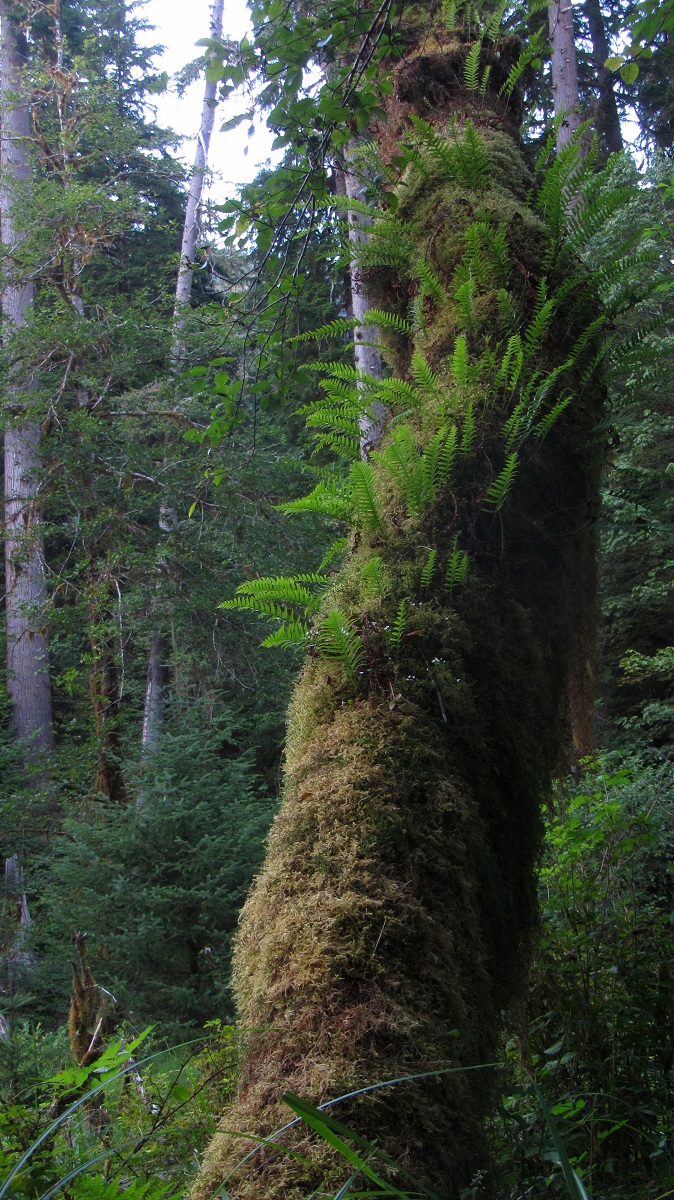
Washington’s Olympic Peninsula is more than 1,800 miles from my home, and it is a world apart from most of what I know.   A day along the Pacific Coast’s tide pools and heading inshore to the Hoh River’s temperate rainforest for the evening hours is a spectacular and sensory-satisfying experience.  No matter where on Earth, the essence of a day in nature is to be surrounded by the beauty of life, to have variety of living forms behaving naturally and in close proximity.  To move slowly, to blend with the surroundings, and to see life approaching and surrounding without worry is to soothe to the pulse of your environment.


Morning began with a farewell to the Quinnalt rainforest’s giant trees and a voyage from sunny skies to sea fog.  We arrived on the Pacific Coast and headed to the National Park Service’s “Beach 4” in search of tide pools.  As the Pacific waters crashed into the beach and rocky crags, fog lifted and drifted into the forest.  We sauntered along in salty air and made our way to some very famous tide pools.   A variety of anemone, sea stars, barnacles, hermit crabs, isopods, and fish kept us busy and marveling.  Having done no homework whatsoever, I took the risk and ran my calloused fingers along the tentacles of an anemone, feeling the “sticky” sensations of the animal’s stinging cells.  The anemone pulled tentacles back toward its simple mouth, and my skin began to feel strangely hot.  The sea stars, rough with a protruding endoskeleton, seemed immobile until we looked closely at their delicate tube feet, prodding and moving slowly along the rocks. 


While the ocean slams against the rocks and tides shape and reshape the sands and pools each and every day, the whole area seems delicate and precarious.  Some of the bowls, so full of life, are formed of sand on nearly 270 degrees of a circle, framed only in part by rock.  One missed step, and the sand collapses into the bowl, making life miserable for a mature anemone.    Small kelps form rich forests of life with strange crustaceans darting in and out of cover.  Though everything seems familiar to me in its rough taxonomic position, every species here is new to me.  A flurry of activity, a small flock of Northwestern Crows erupts in nasal “Caaah caaah caaah” calls, reminding me that even the birds here are different.   With less fog, perhaps I could even see a whale.  I am as alien to this place as the gently rocking tentacles of anemone are to me.  


As the sea fog lifts and heads inland, so does an Olympic Peninsula traveler.  We headed up the Hoh River basin and made camp within the Olympic National Park boundaries.  By afternoon, we had played in the ice-cold glacial waters of the Hoh, and, by early evening, we had found our way to the cobbles of the river flats.  I’m not sure why, but a wise old soul had stopped by our camp to tell us a secret about elk.  We followed him to a small, brushy area amid sand flats, cobbles and giant dead-fallen trees.  The elk were coming to feed.

Within minutes, we found ourselves at the limits of what the park allows, a mere thirty meters from the elk.  But we weren’t approaching them.  Unhindered, they closed in on us from two sides.  We stood, quietly, respectfully, peacefully, enjoying the antics of the herd.  Calves sought their mothers, cows fled a young bull and eagerly found the company of each other and a larger, older bull.   A small spike bull seemed to be the much-loved and non-threatening friend to all.  Elk passed by us, unnoticed until the last second as they crept along the opposite sides of gigantic fallen trees, and, when impeded, they utilized graceful power to bound over the logs to the other side.  


For as long as I can remember, mutualism has been taught to me...and I have taught it to others...as a relationship wherein both species benefit one another.  This is romantically portrayed as a peaceful, caring transaction between individuals.  Now, having watched the elk, my knowledge of this is deeper, more realistic, and a bit more comical.  As a cowbird attempted repeatedly to alight upon a cow elk, the elk repeatedly shooed it away with wiggling, jittery skin.  Finally, she snapped her head around and tried to bite the bird.  The cowbird reluctantly flew to the ground and began foraging by the cow elk's feet.


The Roosevelt Elk is a smaller subspecies and very unique to the old growth temperate rainforest.  As much as politicians have waged war over preserving the old growth forests, and as much as the Northern Spotted Owl has been vilified for “stopping jobs,” we mustn’t forget that important populations of wild salmon, entire plant communities, and these majestic elk are as dependent upon the old growth as the embattled owl. Single species conservation doesn't work.  Conservation does the work of protecting entire ecosystems and must work at all levels, from microhabitat research to battles against climate change.  There is great depth to nature's web.  


As the setting sun passed behind the mountain, we settled into the lap of luxury and just, simply, watched.


My usual dynamic duo: Canon 40D and 300 f4 IS Canon lens, Gitzo basalt tripod and ball head.  My usual sidekick: Canon Powershot SX230HS.   My usual support: Cindy, Zach and Megan!

Monday, August 27, 2012

Out of Sorts: A Naturalist in Another Place

Pacific Birds of Opportunity                   14 August 2012


Gulls are opportunists, no doubt.  So are ornithologists and bird photographers.     For now, in my flight of fancy, I wish to share a few images from this day.  Since my own “rules” for the blog is that each day in nature is devoted a single entry, this is one blog entry that will grow.   It was a very big day, so come back again and stay tuned! 


Washington State’s Olympic Peninsula!  We enjoyed a day of beauty and great luck.  Hurricane Ridge provided a spectacular show as Pacific Ocean sea fog rolled into the valleys and ascended as cloud cover into the high country, wrapping and embracing snow-capped mountain peaks and glaciers.   Broad-leafed alpine lupines and magenta paintbrush flowers were in full bloom, and Sitka black-tailed deer fawns made appearances in protective woodlots.


A lunchtime hike and a day of “making miles” by car put us (delightfully) behind “schedule.”   What, in all of the beauty of Washington, especially in vacation, could dictate a schedule?  Actually, that would be a ferry schedule.

We were the last car of the last ferry before sunset.  We made it.  As our ferry finished the short crossing and we were called to return to our vehicles, I noticed a rock pile full of gulls.  Sprinkled along the white-washed rocks were Western Gulls, Glacous-winged Gulls, and, more exciting to a Wisconsinite, the Heermann’s Gulls so unique to the area.    The sun dipped low on the horizon, warming the photography light and making my heart skip a beat.  How great it would be to get to those rocks!  That’s when I noticed the parking lot and easy access.  It would be a reality!


Within minutes, I found myself sauntering along through a diverse group of gulls, shooting images and feeling very lucky.  

A strange, high-pitched squealing or screaming soon caught my attention.  While I had first thought it may be young gulls, my taxonomist’s brain quickly placed the sound as “new and unknown.”  This was weird.  I knew it was a bird, but it wasn’t anything remotely close to what I knew!  I searched the rocks and quickly found the answer.  Pigeon Guillemot! Alcid seabirds!  While this may not be exciting for somebody living on the coast, this is bird Heaven for a Great Lakes mid-continent land lubber.  


I sat on a rock and took on a low profile, waiting to see what would happen.  Within minutes, Pigeon Guillemots were flying from open water to rocks and perching on their hocks just a few meters away!  Here, before my eyes, one ecological lesson played out in grand fashion—Phosphorus cycling.  As phosphorous, a valuable and limiting nutrient is extracted from the sea through the food web, it is the birds that fly the phosphorous high and above the sea.  In their droppings, they deposit the valuable nutrient back along the edges of the sea where it slowly erodes from rock faces, back to the beginnings of the food web.  It is the wings of sea birds that cycle the Phosphorus and so contribute to the continuity of life’s webs. Bird guano whitewash is beauty on the rocks.


I had always known from pictures that pigeon guillemots were black and white seabirds, but I never appreciated how unique they are.  Bright red feet, to my sudden surprise, were complemented by a bright red mouth.  In the evening light, these birds glowed. 


Wildlife images were made with my favorite combination: Canon 40D and 300mm f4 IS lens.  I shot Aperture Priority, but I worked the exposure compensation a bit.   Landscapes were made with the Canon Powershot SX230HS, a camera that continues to surprise me with its quality as a “point and shoot.”

Friday, August 3, 2012

Breakfast with a Tanager

A Young Bird Reveals Volumes About Feeding Niche                    3 August 2012
Scarlet Tanagers are tropical birds, spending most of their lives there.  But they are hatched in the temperate portions of eastern North America, and the beginnings of a journey to the tropics are hinged on the successful exploration of a feeding niche in northern climates.  This Scarlet Tanager was likely a Wisconsin nestling just a few weeks ago, and it is on its way to Central America. 

I shared my breakfast with the tanager this morning.  This, of course, requires clarification.  I did not share food with the bird, and we did, in fact, have different feeding niches to occupy.  But the simple fact remains that, while I was perched on my deck, the young tanager was perched in an elm at the corner of the deck.  I got a front row seat into this bird’s search for food while I enjoyed some good grains.  I am glad I didn’t eat what the tanager found.   

The tanager seemed obsessed with a strategy of staring obliquely along the decurved leaves of the elm boughs.  If you haven’t peeked ahead at the images, perhaps you can spot the bird’s meal before it does.  The meal is clearly visible in one of these images!   A sharp eye is part of the tanager’s exploration of leaves for insect prey.   

The beak of a tanager is a piece to the puzzle, defining an opportunistic life building a diet rich in insects and fruits.

August has arrived, and tropical species of birds have already begun their southerly waves of migration.  Despite the sometimes oppressive heat of the “dog days” of summer, a hint of autumn is in the air in the changing hues of tree leaves, in the ripening of late berries, and on the bustling wings of chatty fledglings and migratory birds.  Everywhere, food abounds!

These images were made in lightly overcast, even light with a 300mm lens (Canon f4, IS) and a Canon 40D.   I shot at ISO 200 and ISO 400 to keep shutter speeds high.  The young bird was somewhat tame.  A fluffy white line along the bird’s wing left some doubt as to the bird’s identity, so I crept back into the house to get the camera.  My initial efforts were to simply document a “Western Tanager” in Wisconsin.  As it turned out, the bird was a Scarlet Tanager common to my locale, but the role of the camera quickly changed from species documentary  to behavioral documentary.